

Presenting Almost-World: Below are a few highlights. For a little more detail see the pages on the left for aspects of almost-world (a world we all more-or-less live almost-in).
Almost-Art
There are a lot of things that fall somewhere between what we call "art" and what we call "non-art." This "almost-art" could be a chair, a fishing pier, an infant's crayon drawing, or
just a few brush strokes within a whole artwork like the Mona Lisa. To define almost-art
is to define the "gray areas" around and in art.
. . . continue . . .
Almost-Engaged
There are many things to consider before getting married. The mutually agreed-upon decision to become officially engaged is the last of many steps on the road toward the jewelry store. People go through
the early stages of a relationship quickly (weeding out "unacceptables"); and then, typically, go through a much longer
and more serious (ha-ha-ha) period of almost-engagement. So why not make it almost-official?
. . . continue . . .
Almost-News
Almost-news is that which does not sufficiently inform. Perhaps some of the important parts have been left out (more at 11), or perhaps the communication would be better described as advertising or entertainment. You might also call it almost-news if it was mostly a repetition of what you already know (because at 11 you just got the 6 o'clock version plus a "live shot" recounting a personal anecdote).
. . . continue . . .
Almost-Quality
We all need and expect quality, but we only get something that fits
on a scale of quality (more or less). There's almost-always room for improvement, but we all wish there wasn't quite so much.
. . . continue . . .
Almost-Travel
Why go there when you can just call, or look at a picture book, or talk to people who have been there, or view some video on YouTube?
. . . continue . . .
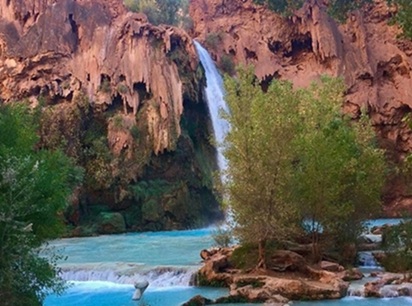
Havasu Falls, Grand Canyon, Arizona, USA
Almost-War
We know what a hot war is, and a cold war, a guerrilla war, an on-again off-again
war (almost-decided). When weapons became too powerful, all-out war became "mutually
assured destruction" (or MAD), and we had to learn to fight the "almost-way."
Almost-war has become the norm now, so much so that we have clear and distinct
types or categories of almost-war.
. . . continue . . .